
Montgomery Clerk Office
The Montgomery County Clerk of Superior Court is the elected constitutional officer for Superior and Juvenile court records. The official county page describes the office as responsible for protecting and permanently maintaining citizens' court, land, cadastral, map, survey, and office-held funds records. GSCCCA lists Tammy C. Foskey as Montgomery County Clerk of Superior Court, year elected 2017.
The clerk's scope is broader than case files. The office manages court records, real estate records, UCC filings, notary public appointments, fine collection and disbursement, transfer and intangible tax collection, trade-name registrations, military discharge records, attorney bar admissions, jury management, and certain Board of Equalization duties.
The county staff details in the research also identify Clarissa Ledford or Howell as Chief Deputy Clerk and Jane Peterson as clerk staff on the county page. Those staff details are useful for confirming that a request has reached the court-record office, but the public should still use the main office phone and official clerk page for current routing.
Montgomery County Clerk of Superior Court
Clerk: Tammy C. Foskey
400 S. Railroad Avenue
P.O. Box 311
Mount Vernon, GA 30445
912-583-4401
Fax: 912-583-4343
Monday-Friday, 8:30 AM-5:00 PM
The official clerk page lists clerk duties, staff contacts, and Board of Equalization support details.
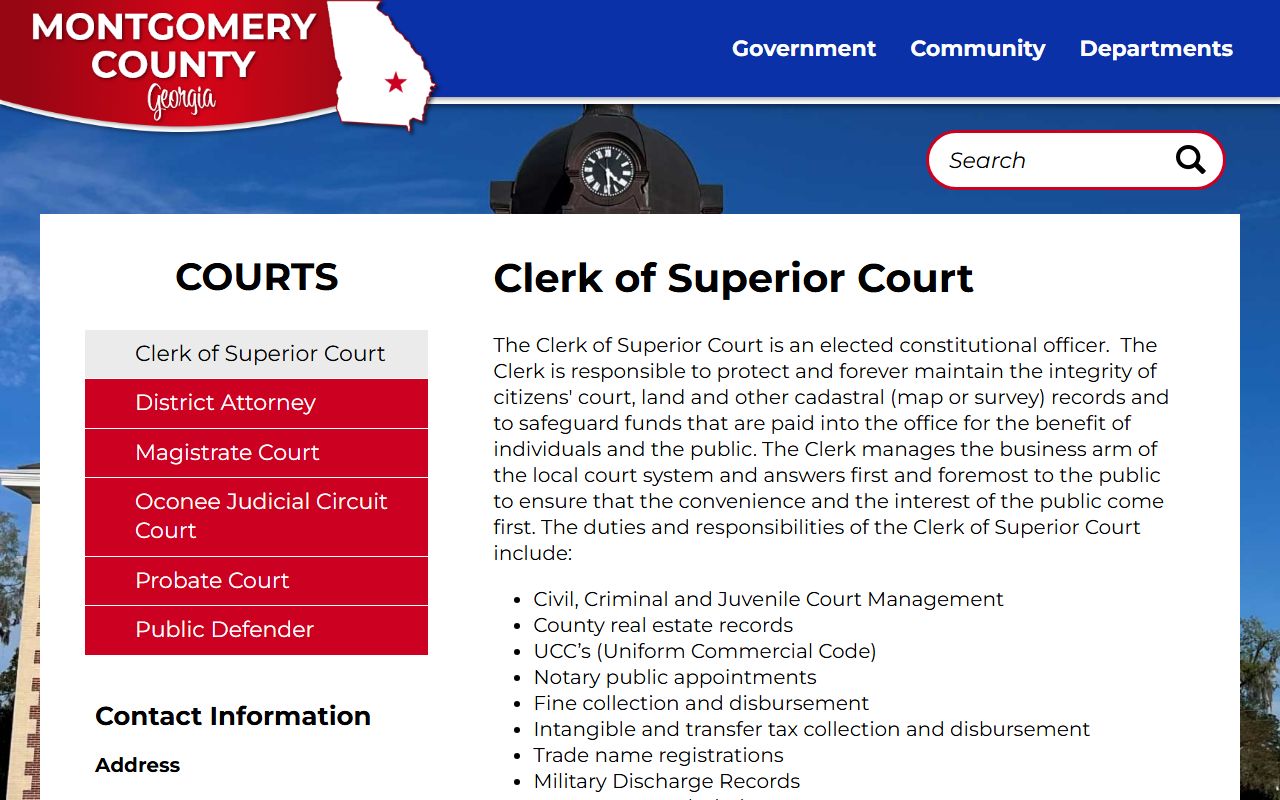
The county page is the best local source for current staff roles and the clerk's broad record responsibilities.
Montgomery Clerk Duties
For court records, the Montgomery County Clerk of Superior Court manages civil, criminal, and juvenile court records. Felony criminal case files, divorce files, major civil actions, land-title matters, equity matters, and juvenile court management route through this office unless Georgia law restricts access. Probate Court and Magistrate Court keep their own records for the matters assigned to those courts.
The split matters in daily searches. A felony disposition, divorce decree, Superior Court judgment, lien, real estate instrument, UCC record, trade name, notary appointment, or military discharge question belongs with the Clerk of Superior Court. An estate, will, guardianship, marriage license, vital record, firearms license, or Probate traffic question belongs with Probate Court. A small claim under $15,000, eviction, garnishment, warrant, first appearance, bond hearing, or preliminary hearing question belongs with Magistrate Court.
- Civil, criminal, and juvenile court management
- Real estate, UCC, lien, trade-name, and military discharge records
- Notary public appointments and related clerk processing
- Fine collection and disbursement
- Jury management and attorney bar admissions
- Board of Equalization hearing, roster, notice, appointment, and training support
The GSCCCA Montgomery County clerk listing confirms the clerk's name, courthouse address, hours, phone, fax, services, and county code.
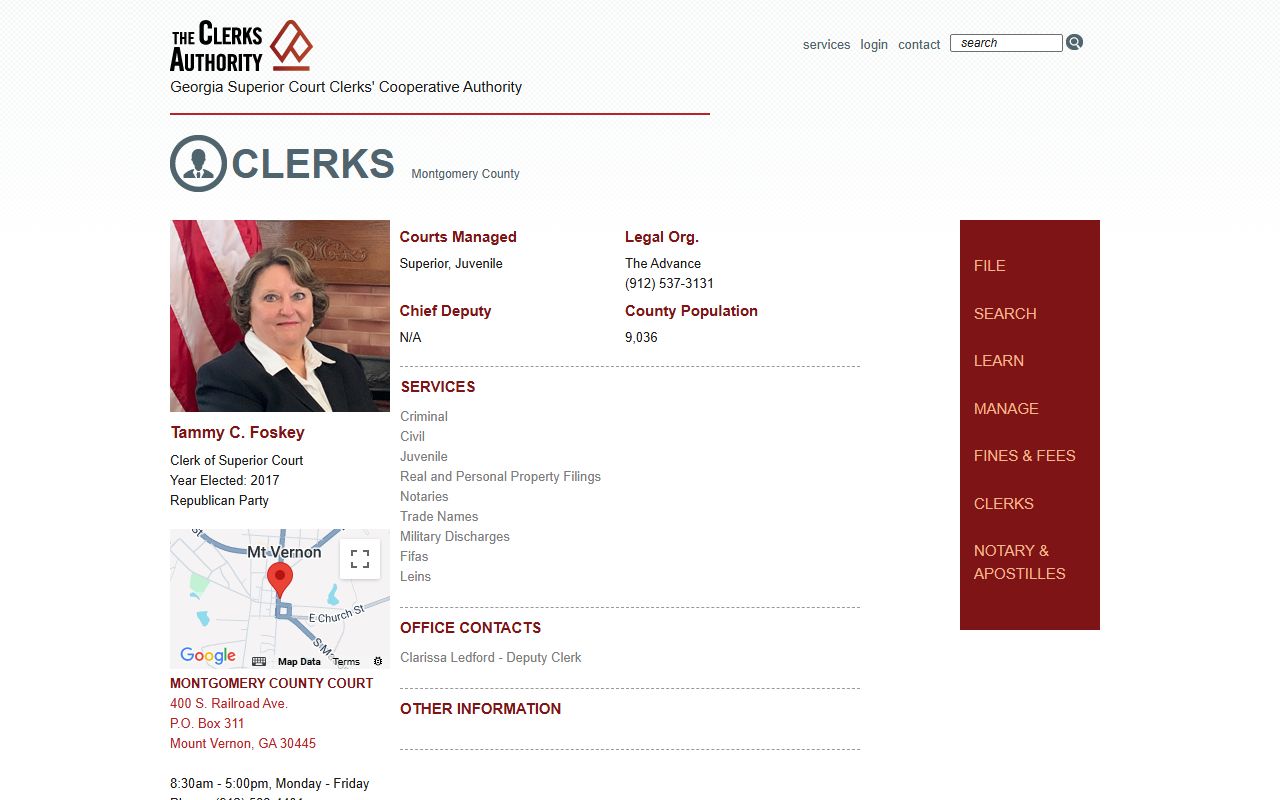
GSCCCA is also the statewide access point for several clerk-linked record and application tools.
How to Request a Certified Copy
A certified copy is a clerk-issued copy that carries official certification for use outside an ordinary file review. It may be needed for divorce decrees, judgments, orders, trade-name records, real estate instruments, or other filed documents when another office requires proof that the copy came from the court record.
- Identify the record type first. Superior and Juvenile files go to the Clerk of Superior Court, while estate and marriage license records go to Probate Court.
- Gather the case number, party names, approximate filing date, document title, and whether the copy must be plain or certified.
- Call 912-583-4401 to confirm fee, copy availability, payment method, and whether the request can be handled by mail.
- Submit the request in person or by mail to the Clerk of Superior Court at the courthouse address or P.O. Box 311.
- Wait for the clerk to prepare the copy, certification, and any mailing instructions. Older files may require additional search time.
Note: Juvenile records and sealed or restricted criminal records may require party status, attorney authority, statute-based access, or a court order.
Records Request Form Fields
No Montgomery County-specific online records request form was located for clerk records. A useful written request should give enough detail for staff to find the file without guessing. The Georgia Governor's Open Records example form includes first name, last name, email, phone, address, and comments, but court-file copy requests are normally made to the clerk that holds the file.
For divorce records, the clerk's office is the local copy source when the divorce was granted in Montgomery County Superior Court. Georgia vital-record resources may confirm divorce information, but certified divorce decrees are requested from the Superior Court clerk in the county of divorce.
| Field | Required | Notes |
|---|---|---|
| Case Number | No, but helpful | Fastest way to locate a Superior Court civil, criminal, or divorce file. |
| Party Names | Yes | Use plaintiff/defendant, state/defendant, or petitioner/respondent names. |
| Approximate Filing Date | No, but important | Helps with older or paper files. |
| Document Type | Yes | Order, judgment, decree, deed, lien, trade name, UCC, or other record. |
| Copy Type | Yes | Plain copy, certified copy, or file inspection. |
| Requester Contact | Yes | Name, phone or email, and mailing address for follow-up. |
Montgomery Clerk Fees
The research did not locate a Montgomery County-specific Superior Court filing or copy fee schedule on the official county pages. The clerk should be called before filing or ordering copies. Georgia Superior Court Clerks' Association posts statewide cost schedule resources, but local handling and the exact document requested still matter.
For open-records requests, Georgia's public-record framework allows reasonable search, redaction, and production charges, and the state example notes that the first 15 minutes may be free. That open-records process is most useful for agency records. Filed court documents are usually requested through the clerk's copy process, and restricted, sealed, juvenile, or confidential material may not be available through either path.
| Item | Amount |
|---|---|
| Superior Court filing or copy fees | Call 912-583-4401. County-specific fee schedule was not located. |
| Statewide Superior Court cost schedule | Georgia Superior Court Clerks' Association posts cost schedule resources. |
| Open-records production | Georgia law permits reasonable search, redaction, and production charges, with first 15 minutes free in the state example. |
| Magistrate Court payments | Cash, check, or money order accepted by Magistrate Court, not credit card. |
| Probate traffic payments | EZCourtPay or 1-800-262-0128 if appearance is not required. |
Montgomery Clerk Online Tools
The Montgomery County Clerk of Superior Court does not publish a full county-branded case-search portal in the research. Online access is split by record type. Land, lien, real estate, UCC, and notary functions are more likely to have statewide GSCCCA tools than a local case-file search box.
- GSCCCA Real Estate Index - statewide index searching for real estate and related instruments.
- GSCCCA Real Estate Name Search - party, instrument type, county, name, date, and display fields.
- GSCCCA Book/Page Search - county, book, and page search for recorded instruments.
- GSCCCA Notary Online Application - county dropdown includes Montgomery.
The GSCCCA Real Estate Name Search page includes party type, instrument type, county, neighboring county choice, name, date range, result count, and table display options.
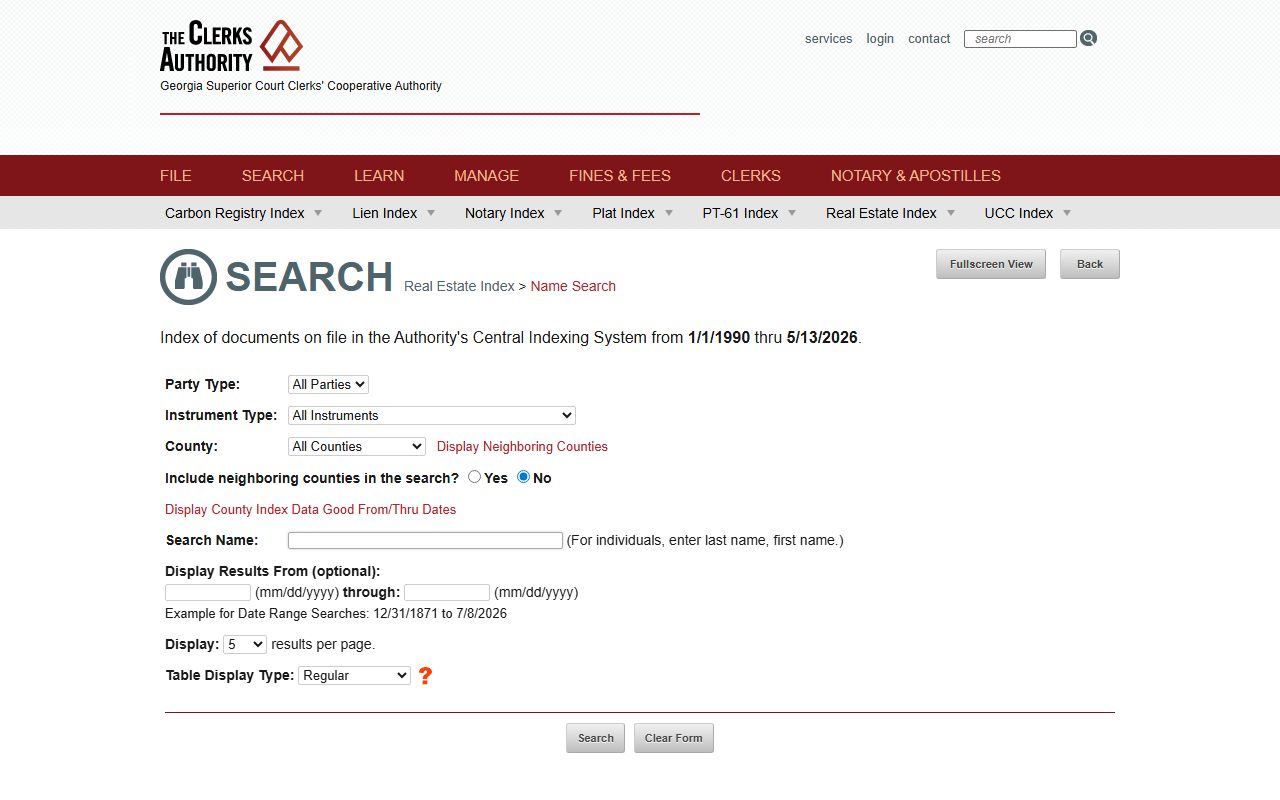
Name search is useful for land and lien context, but it is not a full Montgomery County criminal or civil case docket search.
The GSCCCA book and page search is a narrower instrument lookup.
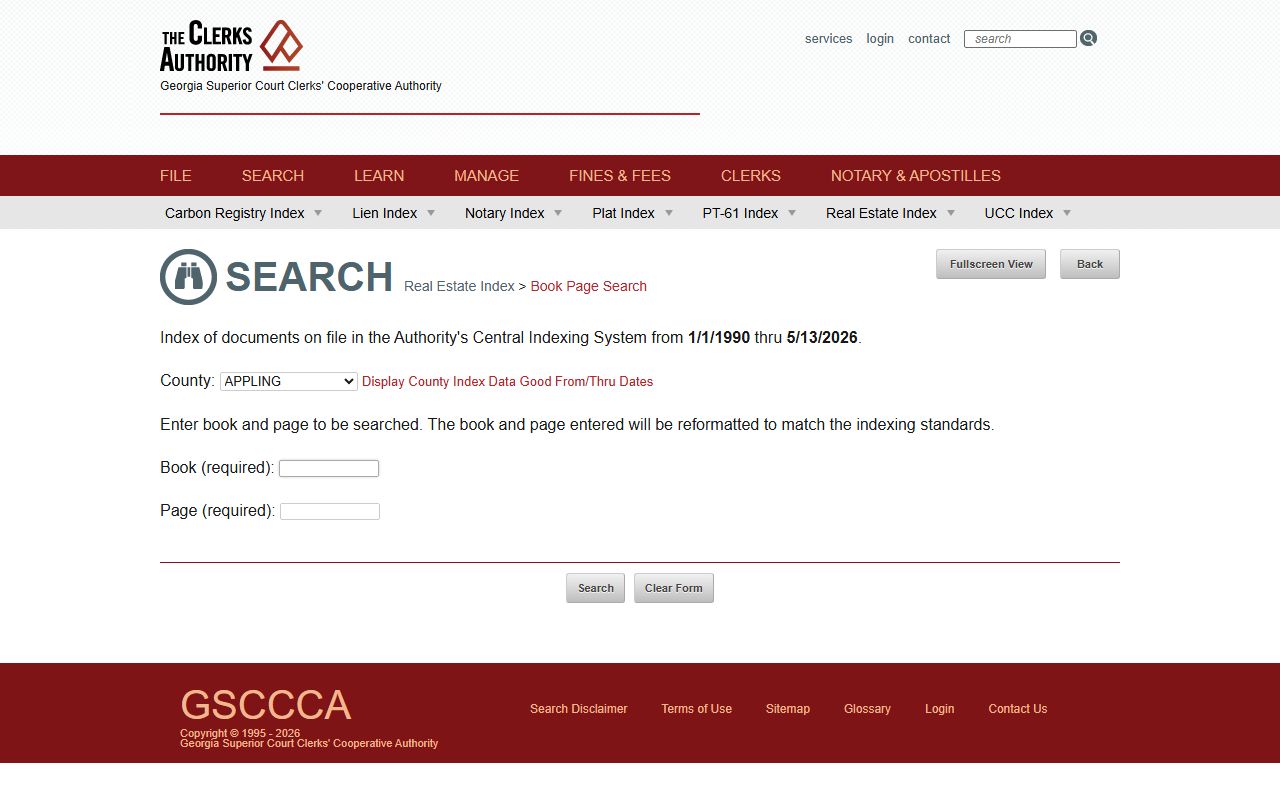
Book and page searches work best when a deed, lien, or recorded instrument already cites those indexing numbers.
These GSCCCA tools should not be confused with criminal case lookup. A person researching a charge, plea, sentence, or felony disposition should contact the Clerk of Superior Court for the court file and may need the case number, defendant name, and filing year. A person researching property, liens, or recorded instruments may be better served by GSCCCA search fields.
Mail and Online Filings
For court eFiling or document access, Georgia users may use PeachCourt when the case type and court participate and the user has or creates an account. The Georgia Courts e-access page says users are redirected to provider websites and that an account is required to search court records. Montgomery County was not identified as a stand-alone public case-search link in the inspected state provider list.
Mail requests should be precise. The clerk's mailing address is P.O. Box 311, Mount Vernon, GA 30445, while the physical courthouse address is 400 S. Railroad Avenue. A mailed request should not use the Probate Court or Magistrate Court post office box unless the record is actually held by that court. Using the wrong office can delay a copy request even when the courthouse building is the same.
Notary applicants can use the GSCCCA Notary Online Application when eligible. The captured field inventory showed a county of application dropdown that includes Montgomery County, and GSCCCA rules state that a Georgia resident applies in the county of residence.
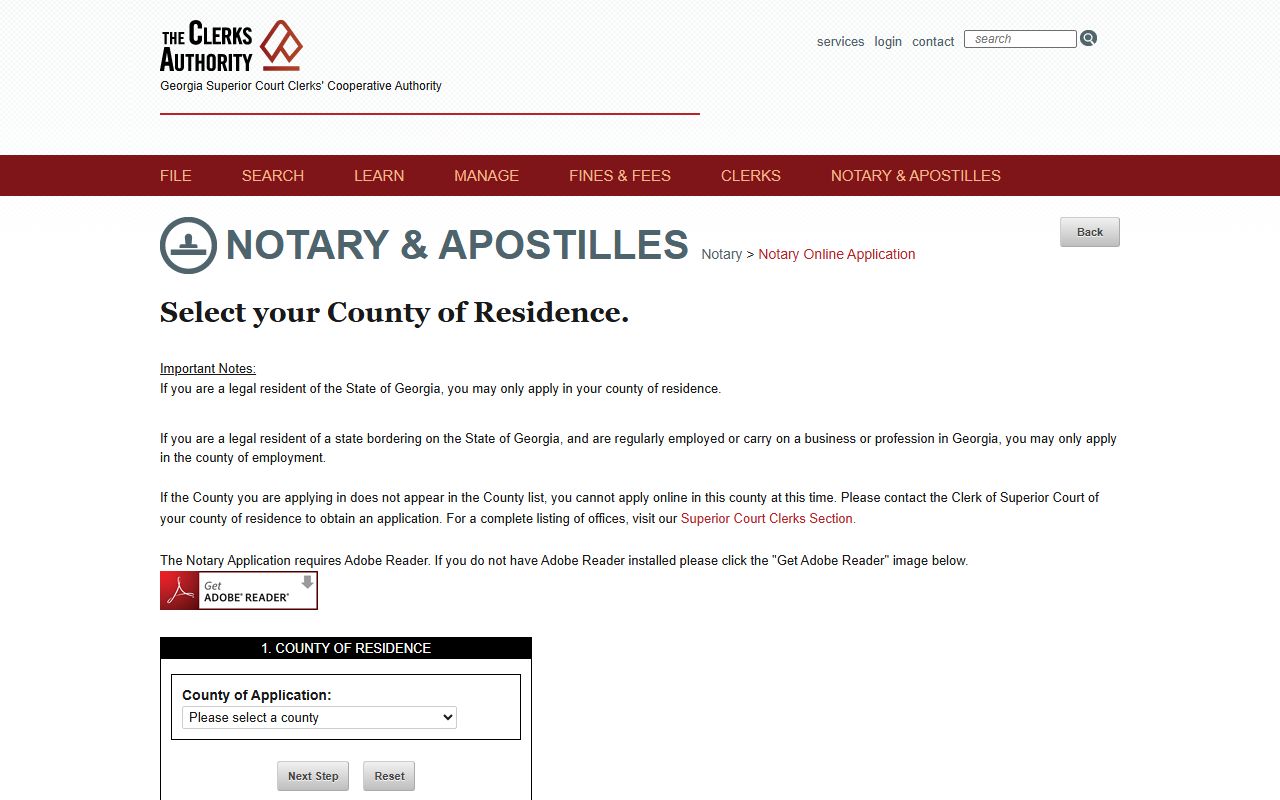
The notary application tool is a clerk-linked service, but it does not replace the clerk counter for certified court copies.