
Montgomery County Criminal Court Records
A criminal court record is the case-level file that follows a prosecution after charges are filed. In Montgomery County, felony criminal cases and some misdemeanor matters in the Superior/Juvenile circuit can include warrants, accusations or indictments, arrest-related charging documents, bond orders, arraignment records, motions, pleas, trial entries, verdicts, sentencing orders, probation conditions, restitution, fines, and disposition entries. These are court records, not just police records.
Montgomery County belongs to the Oconee Judicial Circuit. The Oconee Judicial Circuit Superior Court handles civil and criminal law actions as the general-jurisdiction trial court. The Magistrate Court handles first appearances, bond hearings, preliminary hearings, arrest/search warrants, civilian warrant applications, and some county ordinance matters. The Oconee District Attorney's Office prosecutes felony and misdemeanor cases in the Superior and Juvenile courts of the circuit.
The assigned Montgomery County District Attorney source connects criminal court records to the prosecutor's role in Superior and Juvenile Court cases.
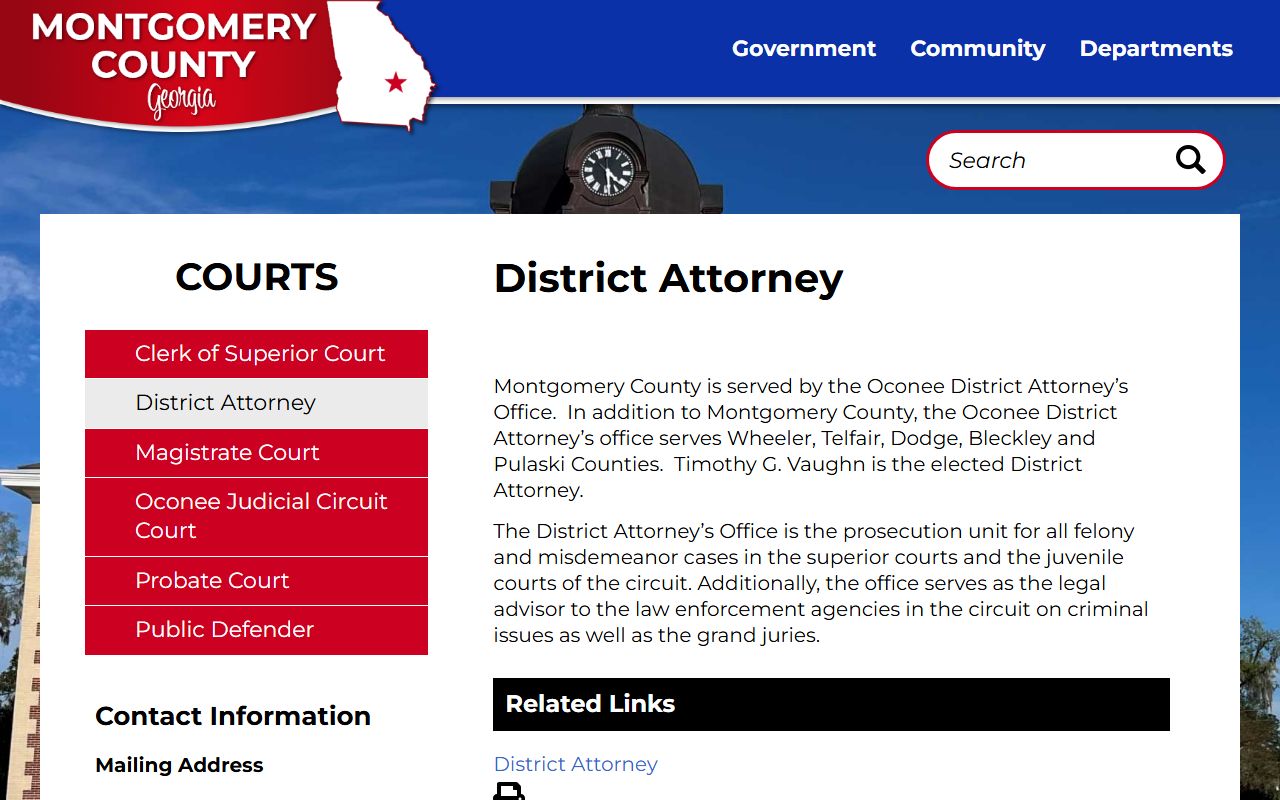
That prosecutor source is important because the arrest charge, filed charge, plea charge, and conviction entry may be different at each stage of the criminal court record.
Search Montgomery County Criminal Court Records
Montgomery County does not publish one full public case-search portal for all local criminal court records. Start with the Clerk of Superior Court for Superior and Juvenile court case files. Use Magistrate Court for first appearance, bond, preliminary hearing, and warrant-related records. PeachCourt may support civil and criminal eFiling or document access for registered users, and Georgia Courts e-access sends users to provider websites with an account requirement. When a portal does not show the case, the clerk fallback is the official path.
- Identify whether the record is a Superior Court prosecution, a Magistrate Court preliminary matter, a juvenile matter, or a city/citation issue.
- Search any available provider account or eFiling/document channel only if it fits the case type and court.
- Contact the Clerk of Superior Court with the defendant name, case number if known, approximate filing date, and charge or disposition information.
- For early criminal events, contact Magistrate Court for bond, first appearance, preliminary hearing, warrant, and warrant-application docket entries.
- Request plain or certified copies from the clerk that keeps the criminal court record, and ask whether any part is sealed, restricted, juvenile, or redacted.
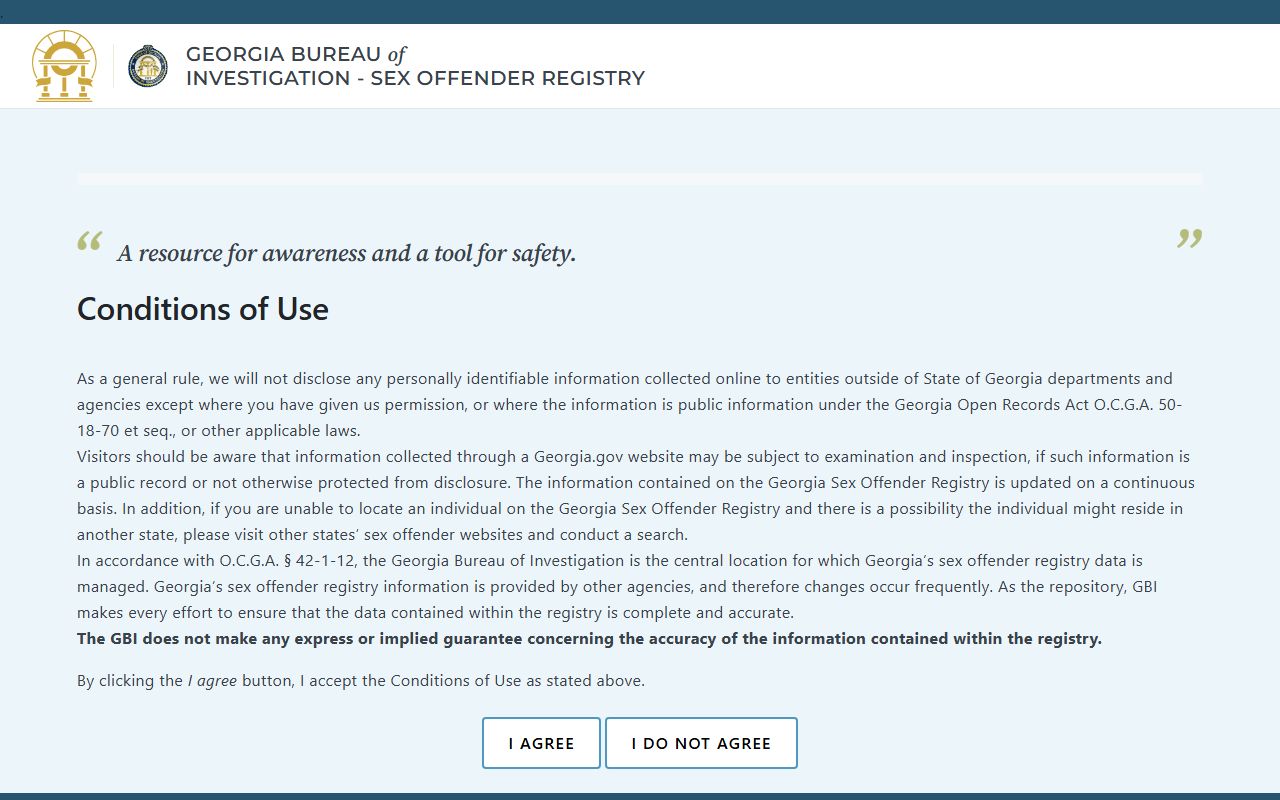
Statewide searches have different uses. The Georgia Department of Corrections Find an Offender search is for sentenced state custody, probation, or parole data, not a Montgomery County court case file. The GBI sex-offender registry is also separate from the criminal court record, though it may reflect registration duties that follow a qualifying conviction.
Montgomery County Criminal Case Flow
A Montgomery County criminal case can start with an arrest, warrant, citation, or investigation, but the criminal court record becomes the key case file when charges move into court. Magistrate Court may handle the first appearance, bond, preliminary hearing, and warrant stages. The District Attorney then reviews charges for prosecution in the Superior Court track when the matter belongs there. The criminal court record grows as each filing, hearing, plea, order, and sentence is entered.
Case flow: Charges Filed › Arraignment › Pretrial / Motions › Plea or Trial › Disposition › Sentencing
| Stage | What Happens |
|---|---|
| Charges filed | An accusation, indictment, warrant charge, or other charging document identifies the alleged offense and starts the court case track. |
| Arraignment | The defendant is advised of the charge and enters a plea such as guilty, not guilty, or nolo contendere. |
| Pretrial / motions | Attorneys file requests for rulings, discovery, bond changes, continuances, suppression, dismissal, or other pretrial relief. |
| Plea or trial | The case resolves by negotiated plea, bench or jury trial, dismissal, nolle prosequi, or another court-approved outcome. |
| Sentencing | If there is a conviction, the record may show jail or prison time, probation, fines, court costs, restitution, and conditions. |
What Montgomery County Criminal Records Show
A criminal case file can show the defendant, court, judicial circuit, judge, filing date, charges, statutes, docket history, attorneys, bond, plea, disposition, sentence, probation, restitution, fines, and court costs. It may also show warrants, citations, indictment or accusation filings, motion practice, hearing notices, orders, verdicts, sentencing orders, appeal entries, and restriction or sealing notations. A short online docket may show only a small part of this field inventory.
| Field | What It Shows |
|---|---|
| Case number | The criminal file number used to locate the docket, filings, orders, and certified copies. |
| Defendant | The person charged, usually with identifying information limited or redacted where required. |
| Charges and statutes | The offenses alleged in the accusation, indictment, warrant, citation, or later amended filing. |
| Bond and hearings | Bond amount or type, first appearance, preliminary hearing, arraignment, and later hearing entries. |
| Plea or verdict | The defendant's formal answer or trial outcome for each charge. |
| Disposition | The final status of each charge, such as guilty, dismissed, not guilty, nolle prosequi, or other result. |
| Sentence | Jail, prison, probation, fines, costs, restitution, and conditions entered after conviction. |
Montgomery County Charges vs Convictions
A charge is an allegation. A conviction is a final result after a guilty plea, verdict, or other court-approved conviction event. Montgomery County criminal court records can show charges that were amended, reduced, dismissed, dead docketed, or not prosecuted. That is why a criminal court record should be read charge by charge, not just by the first offense listed after arrest. For a closer look at arrest charges and filed charge status, use the Montgomery County arrest records and court charges page.
| Charge | Conviction | |
|---|---|---|
| Stage | Alleged offense filed after arrest, warrant, citation, accusation, or indictment. | Final result after plea, verdict, or other conviction entry. |
| Meaning | The state claims the offense occurred. | The court record shows guilt was established or admitted. |
| Can change | May be amended, reduced, dropped, dismissed, or not prosecuted. | Can be appealed, vacated, pardoned, restricted, or sealed only through legal process. |
Montgomery County Criminal Dispositions
The disposition is the outcome of a charge or case. It may show guilty, not guilty, dismissed, nolle prosequi, dead docketed, transferred, or another result. Sentencing entries may list probation, jail or prison time, restitution, fines, court costs, and conditions. A sentence should be read with the charge it belongs to, because one case may contain several counts with different outcomes. If the disposition is unclear, request the sentencing order or final judgment from the clerk rather than relying on a short docket label.
The assigned Public Defender source matters because indigent defense can apply in Superior Court, Magistrate Court, and sometimes Juvenile Court.
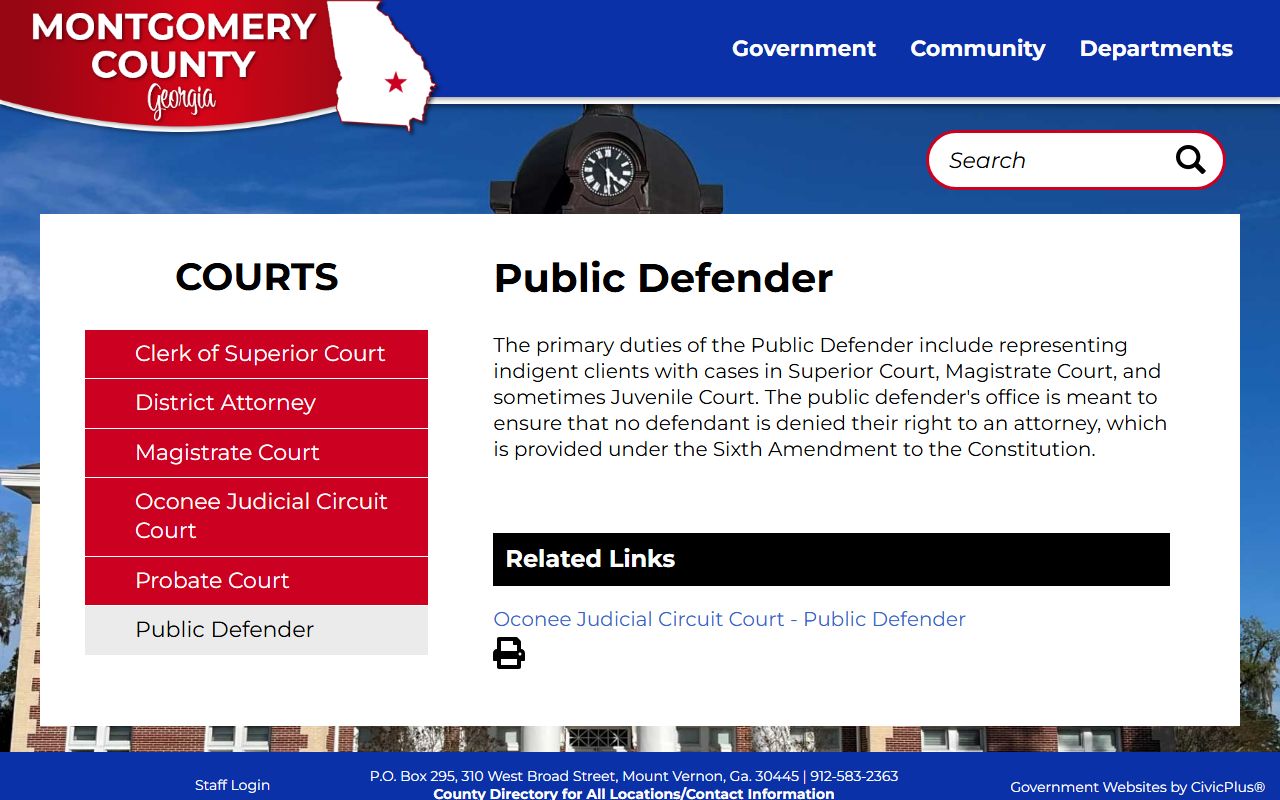
Defense representation can affect the motion history, plea negotiations, bond hearings, and sentencing documents that appear in the Montgomery County criminal court record.
Montgomery County Sealed Criminal Records
Georgia commonly uses the term record restriction for eligible criminal-history information. The research also notes that a person with restricted records may petition the court with original jurisdiction for an order sealing clerk-held criminal-history information. A restricted criminal-history entry and a sealed clerk file are related, but they are not always the same action. Eligibility depends on the arrest, charge, prosecutor action, court, and final disposition.
| Sealed | Expunged | |
|---|---|---|
| Georgia wording | Clerk-held criminal-history information may be sealed by court order when the statute allows. | Georgia research uses record restriction rather than promising file destruction. |
| Public visibility | Public access is limited after the clerk receives a valid sealing order. | Eligible criminal-history data may be restricted from public dissemination. |
| Eligibility | Depends on the court with original jurisdiction, prosecutor notice, privacy interests, and statutory requirements. | May apply to dismissed, not prosecuted, dead-docketed, certain vacated or reversed convictions, pardoned offenses, and some misdemeanor convictions. |
The assigned Georgia criminal history restriction statute source is central to Montgomery County criminal court record access limits.
Use the statute as the starting point, then confirm local petition steps with the court that had original jurisdiction over the Montgomery County criminal case.
Montgomery County Criminal Record Access
Public access to Montgomery County criminal court records depends on the court file, the record type, and any restriction. O.C.G.A. 50-18-70 defines public records broadly for agency records, while court-file access is usually handled through the clerk that maintains the case. Administrative law-enforcement records, jail booking records, and incident reports may require a request to the Sheriff's Office or another agency. Filed criminal pleadings and docket entries should be requested from the court office that keeps them.
Key Statutes:
O.C.G.A. 50-18-70 defines public records broadly for Georgia public-record access.
O.C.G.A. 35-3-37 governs Georgia criminal-history restriction and clerk-held sealing issues.
Montgomery County Criminal Lookup Limits
Montgomery County criminal court records do not replace every state record source. The GBI Sex Offender Registry service page explains the statewide central registry role, and the registry itself is separate from a criminal case docket. The Georgia Department of Corrections offender search is separate too, because it focuses on sentenced state prisoners, probation, and parole status rather than clerk-held filings.
The assigned GBI registry service source and GBI public registry source help separate registry data from Montgomery County criminal court record data.
The GBI public registry search source shows the registry access point, while the conviction, plea, sentencing, and case history still belong in the court record.
Search registry and offender systems only for the data they are built to show, then verify court outcomes with the Montgomery County court file.
Restricted Montgomery County Criminal Records
Several criminal record categories require caution. Juvenile records are more restricted than adult records. Sealed or restricted criminal-history information may be unavailable to the public even when the case once appeared in a docket. Active investigations, sealed warrants, victim data, minor identifiers, Social Security numbers, financial account numbers, full birth dates, medical details, and similar information may be withheld or redacted. A clerk can confirm whether a file exists, but access can still depend on party status, attorney status, statute, or court order.
For arrests before July 1, 2013, the research notes that the restriction statute discusses written requests to the arresting agency and possible fees up to $50. Eligibility remains fact-specific. Montgomery County users should match the record to the arresting agency, District Attorney, Magistrate Court, Superior Court, or another original-jurisdiction court before assuming that a restriction has already changed public access to the clerk-held case file.